Gradium Open-Sources Phonon, a 31M-Parameter On-Device TTS Model Under Apache 2.0
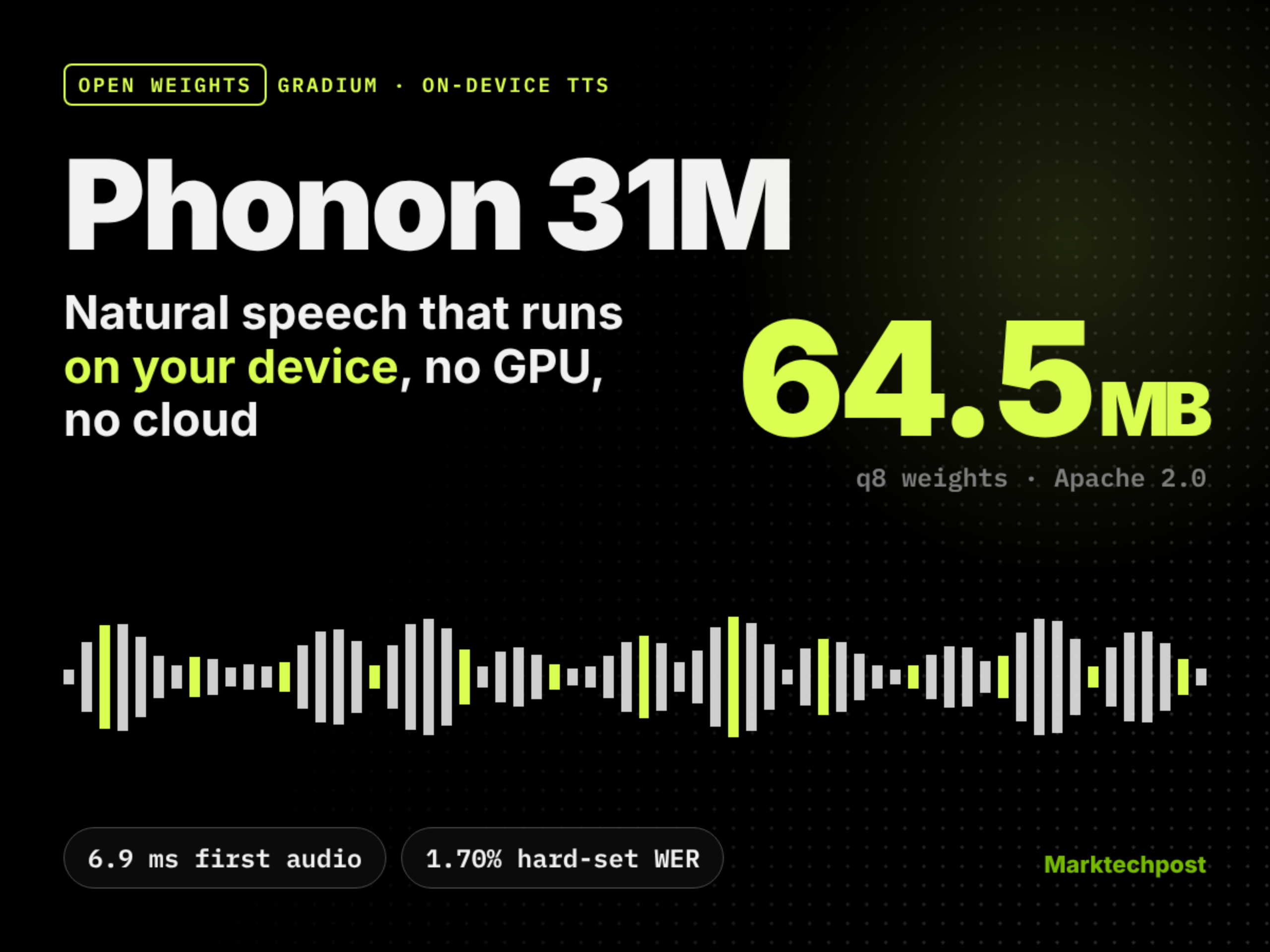


Gradium has open-sourced Phonon, a family of small text-to-speech models built to run on the device. The Gradium Phonon on-device TTS model comes in 31M and 40M sizes. The English Phonon 31m ships under Apache 2.0 and fits in a 64.5 MB file. Developers get natural speech with no cloud call, no GPU and no per-character bill.
TL;DR
- Size: 31M parameters (excluding the audio tokenizer), 64.5 MB q8 GGUF, 24 kHz mono output. Phonon 40m: 40M, 74.6 MB.
- Runs on: CPUs, phones, Raspberry Pi 5, browsers (WASM, WebGPU) and NVIDIA GPUs. No GPU required.
- Performance: top English Elo among open models Gradium tested; about 7 ms to first audio on CPU.
- Best: 1.70% WER on a 500-sentence hard set, versus 3.50% for Kokoro (Gradium’s eval).
- Worst: 0.51% Seed-TTS LLM WER, behind Kokoro (0.45%) and Magpie (0.46%).
What is Gradium Phonon?
Phonon is an open-weight TTS family from Gradium, a Paris voice AI company spun out of Kyutai. It generates speech locally on phones, laptops, boards and browsers.
Open Source
OmniParseBench · by Datalab · Apache 2.0
Benchmark any document parser on tables, math, forms and handwriting.
Yes/no tests per page across text, table and layout families. Score vendor parsers on the Hugging Face dataset or your own PDFs with score and predict primitives.
★ Star on GitHub
The family has three models:
- Phonon 31m: English only, 37 built-in voices, Apache 2.0.
- Phonon 40m: 1 model per language (English, French, German, Spanish, Portuguese), CC BY-NC 4.0.
- Phonon 40m multilingual: all 5 languages in 1 model, 102 voices, CC BY-NC 4.0.
How does Phonon work?
Phonon uses a causal transformer backbone. Its prefix combines text and speaker embeddings. A SentencePiece tokenizer with a 4,000-token vocabulary reads raw text, with no phoneme conversion.
The backbone generates 1 latent vector per 80 ms frame. A flow-matching head turns that vector plus noise into an audio embedding in a single step. A smaller variant of Kyutai’s Mimi decoder then outputs 24 kHz PCM audio. A separate end-of-speech head decides when to stop.
Phonon 31m uses 6 transformer layers, width 512 and 8 attention heads. Phonon 40m uses 9 layers at the same width. Both are distilled from a larger Phonon teacher. Training ran on an NVIDIA H100 cluster with NCCL and CUDA Graphs.
The work builds on Kyutai’s Continuous Audio Language Models research and Pocket TTS.
How does Phonon perform on benchmarks?
Gradium ran blind pairwise listening tests with 1,189 raters and 17,270 votes. In US English, Phonon 40m scored 2117 Elo and Phonon 31m scored 2098. Kokoro scored 2043, NeuTTS 2034 and Magpie 1939.
Accuracy was tested on a public hard-sentence set. It holds 500 sentences per language, full of phone numbers, emails and postal codes. Phonon 31m scored 1.70% WER against 3.50% for Kokoro and 8.71% for NeuTTS Nano.
Built-in text normalization drives much of that gap.
On the easier Seed-TTS set, the gap closes. Phonon 31m scored 0.51% LLM WER, while Kokoro scored 0.45%.
How fast is Phonon on a CPU?
On a MacBook Air M5 CPU with 4 threads, Phonon 31m reaches first audio in 6.9 ms. It runs 29.9x faster than real time. Kokoro takes 517 ms, because it does not stream. With Arm KleidiAI and Apple Accelerate, Phonon 31m reaches 46.7x real time.
On a Raspberry Pi 5, Phonon 31m starts in 38 ms and runs 3.7x faster than real time. Gradium says Kokoro needs 7 seconds to start there.
On Snapdragon 8 Elite Gen 5, Phonon starts in 7.5 ms at 24x real time. On an NVIDIA L40S, CUDA reaches first speech in 5 ms. An AMD EPYC 7413 CPU takes 43 ms, per the press release.
Comparison: Phonon vs Kokoro, NeuTTS Nano and Kitten TTS
Benchmark rows come from Gradium’s blog and model card. Size, language and license rows come from each model’s own card.
How can developers deploy Phonon?
The runtime is MIT or Apache-2.0 licensed. It covers Rust, Python (pip install ptts), Swift, C, C++ and the browser via phonon-tts. It also ships an OpenAI-compatible server and a WebSocket server.
Phonon loads in Transformers, MLX-Audio, Ollama and LM Studio. Voice cloning and voice design run in Gradium Studio, then the voice runs locally.
Key Takeaways
- Phonon 31m is a 31M, 64.5 MB English TTS model under Apache 2.0.
- It reports 1.70% WER on hard text, against 3.50% for Kokoro.
- First audio arrives in 6.9 ms on a MacBook Air M5 CPU.
- It runs 3.7x faster than real time on a Raspberry Pi 5.
- Multilingual 40m models exist, but under a non-commercial license.
Check out the technical blog, model card, GitHub runtime and hard-sentence dataset. All credit goes to the researcher of this project. Also, feel free to follow us on Twitter and don’t forget to join our 150k+ML SubReddit and Subscribe to our Newsletter. Wait! are you on telegram? now you can join us on telegram as well.
Need to partner with us for promoting your GitHub Repo OR Hugging Face Page OR Product Release OR Webinar etc.? Connect with us
Asif Razzaq is the CEO of Marktechpost AI Media Inc.. As a visionary entrepreneur and engineer, Asif is committed to harnessing the potential of Artificial Intelligence for social good. His most recent endeavor is the launch of an Artificial Intelligence Media Platform, Marktechpost, which stands out for its in-depth coverage of machine learning and deep learning news that is both technically sound and easily understandable by a wide audience. The platform boasts of over 2 million monthly views, illustrating its popularity among audiences.