
Bitcoin miners pour billions into AI


Bitcoin miners are redirecting billions of dollars and scarce power capacity toward artificial intelligence as BTC’s downturn pushes mining profitability close to historic lows.
Data from CryptoSlate shows Bitcoin trading around $64,000, nearly 50% below its October peak, while elevated network competition and weak transaction fees continue to squeeze miner revenue.
Those pressures have made AI infrastructure increasingly attractive because data-center customers can pay substantially more for reliable electricity and long-term capacity, giving miners another way to monetize power assets that are becoming less profitable when devoted solely to Bitcoin.
Some of the industry’s largest operators are already converting facilities, signing multi-year computing contracts and, in some cases, pulling back from investment in new Bitcoin mining equipment.
However, André Dragosch, head of research at Bitwise Europe, told CryptoSlate that miners may be making that shift at the wrong point in the cycle.
He argues that expectations for AI compute demand, including demand generated by autonomous agents, could take longer to materialize than current investment implies. At the same time, he believes Bitcoin is approaching the end of its downturn.
That combination creates a potential timing problem: miners could spend the next year committing capital and power capacity to AI just as a recovery in Bitcoin prices restores the economics of mining.
Dragosch therefore believes some miners making the pivot today could regret the decision within the next 12 months.
Mining economics make the AI pivot difficult to resist
The economics facing Bitcoin miners make Dragosch’s contrarian call difficult to act on today.
Bitcoin’s April 2024 halving cut the block subsidy from 6.25 BTC to 3.125 BTC, reducing the number of new coins miners receive for securing the network. The more recent decline in Bitcoin’s price has compounded that pressure by reducing the dollar value of those rewards.
Miner revenue has deteriorated alongside Bitcoin’s price. VanEck reported that miners’ daily revenue has declined nearly 40% year over year and currently averages roughly $28.5 million over a 30-day period.
At the same time, elevated network hashrate has kept competition for those shrinking rewards intense.
Hashprice, which measures miner earnings per unit of computing power, has fallen to about $30 per petahash per second per day after reaching record-low territory earlier this year, leaving older and less-efficient machines at or below breakeven depending on electricity costs.
For some miners, that gap has become large enough to justify abandoning further expansion of their Bitcoin fleets.
Core Scientific, once one of the largest Bitcoin miners, has said it no longer plans to spend on new equipment to maintain or expand hashrate. Instead, it intends to extract cash from its existing mining fleet while directing more power toward high-density computing.
Its second-quarter results show why that trade has become compelling.
Colocation revenue surged to $136.7 million from $10.6 million a year earlier and accounted for about 83% of total revenue. Bitcoin self-mining revenue fell 66% to $21.5 million and represented just 13%, down from roughly 80% a year earlier.
The profitability gap was even wider. Core Scientific reported a 59% gross margin from colocation during the quarter, while its self-mining business produced a negative gross margin.
Meanwhile, Core Scientific is not alone in this pivot.
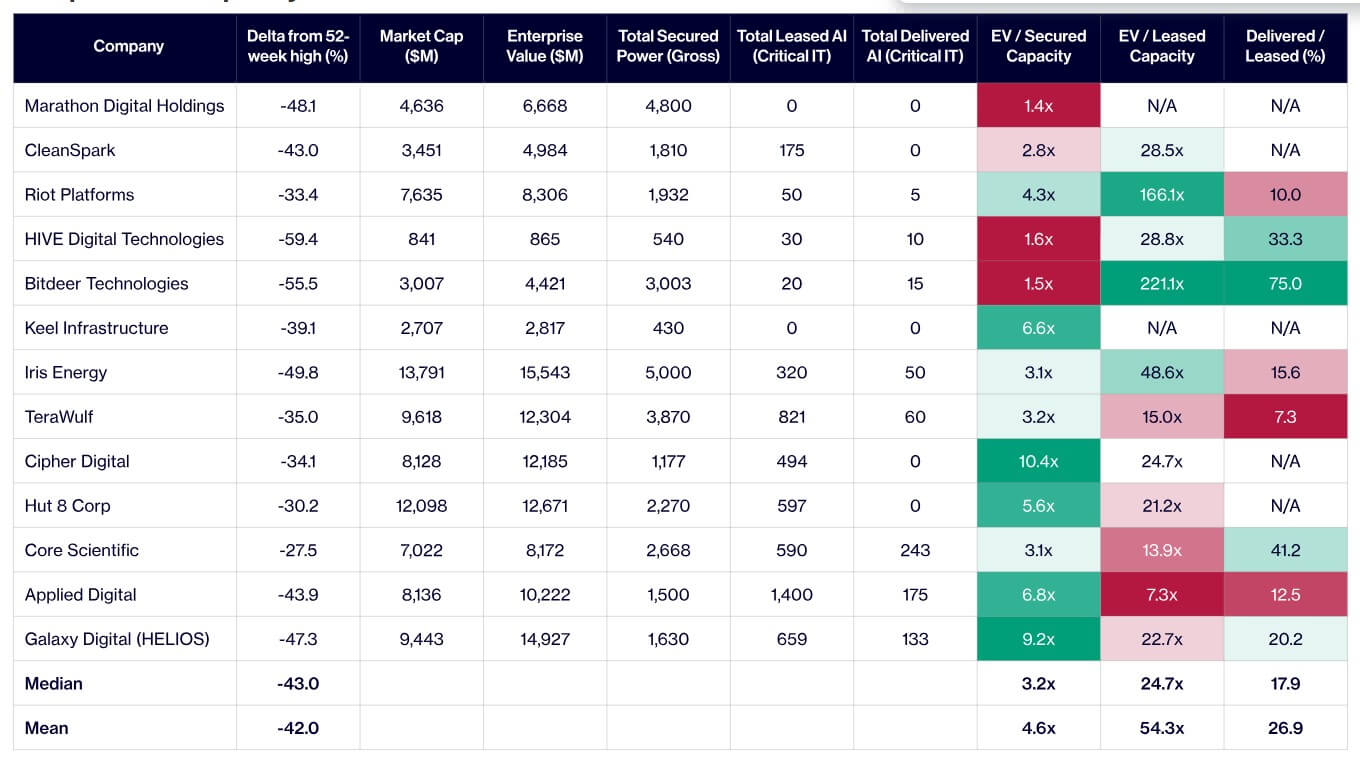
Earlier this year, CoinShares said public miners had announced more than $70 billion of cumulative AI and high-performance computing contracts. The firm estimated listed Bitcoin miners could derive as much as 70% of their revenue from AI by the end of 2026, up from roughly 30%.
MARA Holdings CEO Fred Thiel summarized the economics in a recent interview, saying:
“You get a lot more money per electron if you’re doing it for AI than for Bitcoin mining.”
The shift does not involve converting Bitcoin mining machines into AI hardware. ASICs built for Bitcoin cannot perform the workloads handled by GPUs.
What miners can repurpose is their access to electricity, grid connections, land and data-center infrastructure, assets that have become increasingly valuable as AI developers compete for sites capable of supporting large computing clusters.
Why the AI bet could become harder to unwind
Still, the risk in Dragosch’s thesis is magnified by how expensive that transition can become.
CoinShares estimates Bitcoin mining infrastructure costs roughly $700,000 to $1 million per megawatt, compared with about $8 million to $15 million per megawatt for AI facilities.
That difference means miners moving into high-performance computing are making a substantially larger and longer-duration capital commitment than they would when expanding a Bitcoin mining site.
Those investments are also being made during one of the largest technology infrastructure spending cycles on record.
The Bank for International Settlements estimates the five largest hyperscalers could spend more than $1 trillion on AI-related capital expenditure across 2025 and 2026.
The BIS has warned that intense competition among technology companies could produce excessive investment if commercial returns fail to keep pace with spending.
So, a disappointment in AI revenue could slow new infrastructure development, weaken demand for additional capacity and make financing more difficult for projects built around continued growth in computing demand.
Dragosch is not arguing that AI demand will disappear. He remains convinced AI will be transformative but believes transitions of this scale can take longer to mature than investment cycles imply.
In that scenario, infrastructure supply could expand faster than commercial demand, compressing the unusually attractive economics currently drawing Bitcoin miners into the sector.
The consequences would become more significant if Bitcoin mining profitability recovered at the same time.
Higher BTC prices or an improvement in hashprice could narrow the return gap between mining and AI, but operators that have already committed billions of dollars, power capacity and infrastructure to long-term computing projects would have less flexibility to respond.
The risk, therefore, lies in how much optionality miners surrender while chasing the business offering the better economics today.



