
Spain Crypto Regulation to Allow Account Freezes Without Court Orders


Key takeaways
- Spain’s Royal Decree-Law 44/2026 would let financial intelligence unit Sepblac freeze crypto accounts for up to five business days, and halt pending transactions for up to ten, without a court order.
- The powers take effect January 25, 2027, subject to parliamentary validation; a court must confirm or extend any suspension at the deadline.
- Sepblac and institutions that comply with its orders are protected from liability, and the article does not set out a customer compensation mechanism.
- The decree does not create a way to freeze Bitcoin in self-custody, but exchanges, custodians and some stablecoin issuers can restrict access.
- Spain is implementing elements of the EU’s 2024 anti-money laundering directive, so this is part of a wider European shift.
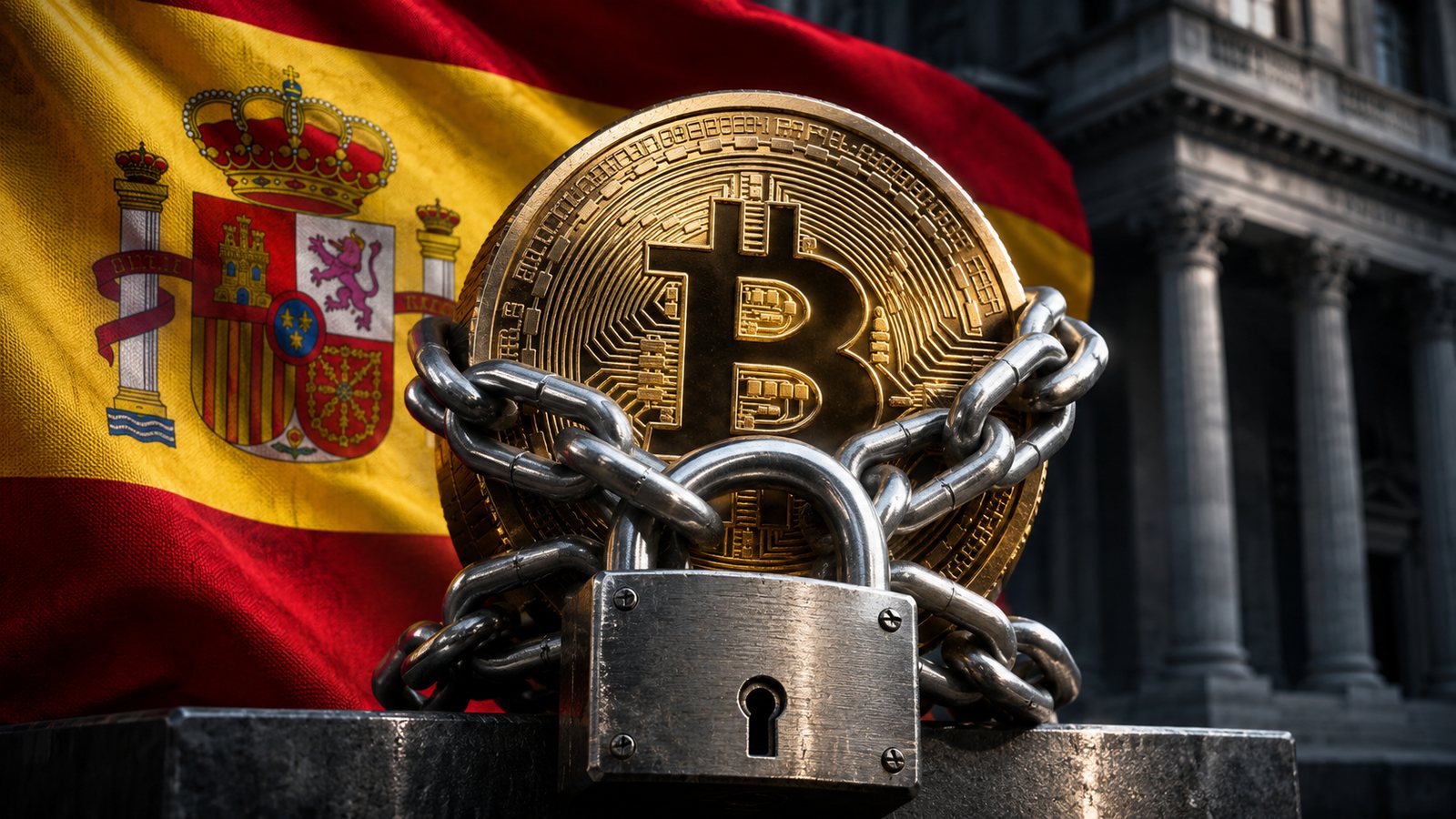
Spain is tightening its crypto regulation with a new measure that would allow the country’s financial intelligence unit to freeze cryptocurrency accounts for up to five business days without first obtaining a court order. Authorities would also be able to stop pending transactions for twice as long.
The powers are contained in Royal Decree-Law 44/2026, dated November 24 and published in Spain’s Official State Gazette on Wednesday. They are scheduled to take effect on January 25, 2027, subject to the parliamentary validation process.
The decision comes at a time when cryptocurrency is becoming more accessible through traditional financial institutions. Bitcoinist previously reported on Santander’s expansion into retail cryptocurrency services, part of a broader shift bringing digital assets into regulated banking environments.
That convenience, however, comes with a different set of risks for investors. The institution holding their cryptocurrency may also be required to prevent them from accessing it.
Spain Expands Its Authority Over Crypto Accounts
The new Article 46 bis of Spain’s anti-money laundering legislation gives Sepblac, the country’s financial intelligence unit, the authority to intervene when it identifies indications of money laundering or terrorist financing.
The measure establishes two separate limits: five business days for accounts and business relationships, and ten business days for individual transactions that are still in progress.
These are maximum periods rather than automatic detention periods. Sepblac must lift the restrictions sooner if they are no longer necessary.
Until now, the government’s explanatory memorandum notes, this particular preventive power had been limited to requests from foreign financial intelligence units. The reform allows Sepblac to act on the basis of its own analysis.
For investigators, the reasoning is straightforward. Cryptocurrency can move between platforms and across borders long before a conventional investigation produces results. An intervention that arrives after the funds have disappeared may be of little practical use.
Global on-chain money laundering grew from $10 billion in 2020 to more than $82 billion in 2025. While these figures are not specific to Spain, they illustrate the broader enforcement challenge facing financial intelligence agencies.
For account holders, the more difficult question is what happens when the initial suspicion turns out to be wrong.
Where Do the Courts Come In?
Spain is not removing the courts from the process entirely. It is changing when they become involved.
A suspension must expire at the statutory deadline unless a court confirms or extends it following a request from public prosecutors. Appeals against the resulting judicial decision fall under Spain’s criminal procedure legislation.
Another provision deserves particular attention. Article 46 bis protects Sepblac, its officials and employees, and institutions complying with its orders from liability when the suspension is carried out in accordance with the law.
The protection is conditional, but it raises a legitimate question about accountability. Five business days without access to funds may be manageable for a long-term investor. For an active trading business or a company relying on cryptocurrency to settle payments, the consequences could be considerably more serious.
The new article does not itself provide a detailed customer compensation mechanism for losses arising from a lawful suspension.
There is also a distinction between freezing assets and confiscating them. A temporary restriction preserves funds during an investigation; it does not establish that their owner has committed a crime.
Can Spain Freeze Bitcoin Held in a Private Wallet?
The practical reach of the reform depends partly on how an investor stores their cryptocurrency.
A centralized exchange or regulated custodian controls access to the assets it holds on behalf of customers. It can therefore restrict withdrawals or block transactions in response to a legally binding instruction.
Bitcoin held directly by an investor presents a different technical situation. The network has no central administrator capable of disabling an ordinary Bitcoin address at the request of a financial intelligence agency.
The decree does not introduce such a mechanism.
Self-custody should not, however, be confused with immunity from legal action. Authorities can pursue assets through other lawful procedures, while some centrally issued stablecoins have technical features that allow their issuers to restrict transfers.
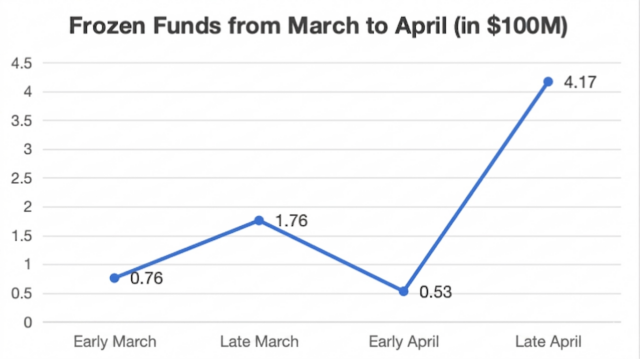
Research from blockchain security firm Beosin shows the scale of these existing controls. Between March and April 2026, approximately $722 million in USDT and USDC was frozen across 1,397 blockchain addresses. These restrictions illustrate the technical authority stablecoin issuers already possess, independently of Spain’s new legislation.
The distinction matters because owning cryptocurrency and having unrestricted access to it are not necessarily the same thing.
Spain’s Decision Is Part of a Wider European Shift
The Spanish reform implements elements of the European Union’s 2024 anti-money laundering directive, which establishes common requirements for the powers of national financial intelligence units.
The directive explains that temporary suspensions are intended to “preserve the funds, carry out the necessary analyses,” allowing investigators to determine whether their suspicions are justified.
Spain’s move should therefore be understood in a broader European context rather than as an isolated national crackdown on cryptocurrency.
The next significant milestone is parliamentary validation. Under Article 86 of the Spanish Constitution, royal decree-laws must be submitted to Congress within 30 days of their promulgation.
If the measure proceeds as scheduled, Spain’s financial intelligence unit will enter 2027 with greater authority to intervene in suspicious cryptocurrency activity.
How that authority is exercised, particularly when innocent customers are caught in an investigation, will be just as important as the legislation itself.

Editorial Process for bitcoinist is centered on delivering thoroughly researched, accurate, and unbiased content. We uphold strict sourcing standards, and each page undergoes diligent review by our team of top technology experts and seasoned editors. This process ensures the integrity, relevance, and value of our content for our readers.


